
Iran strikes, governor using state plane, 2026 campaign news
March 2 edition of "KHOI's Capitol Week"

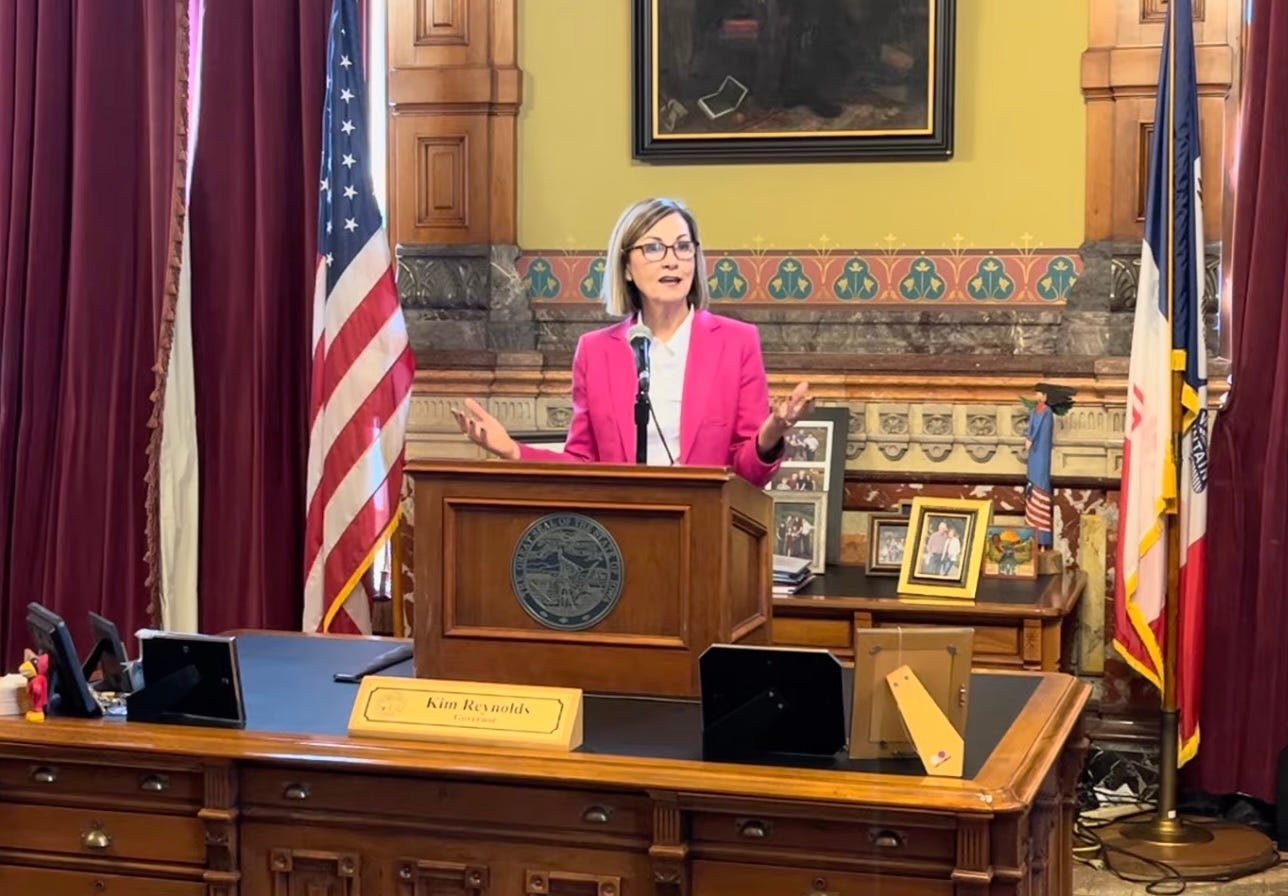
I’m not a podcast watcher. I prefer to listen to the shows I follow, ideally while I’m walking my dog.
But if you like to take in podcasts in video form, I have good news: KHOI Community Radio is now live-streaming our weekly show on their Facebook page. Here’s the link to the video of our March 2 show.
As always, the audio file is at the top of this post, or you can find “KHOI’s Capitol Week” through podcast platforms and smart speakers. Here’s the written recap of what Spencer Dirks and I covered, for those who would rather read than listen. If your email provider truncates this post, you can read it without interruption here.
Iowa Republicans mostly praise strikes against Iran
We began with Iowa reaction to the biggest global news story. On Friday night the U.S. and Israel began bombing Iran. President Donald Trump said in a video statement that Iran “rejected every opportunity to renounce their nuclear ambitions, and we can’t take it anymore.” He has since called for regime change and claimed the military operation may take “four weeks or less.”
Some of Iowa’s Congressional delegation cheered the news. Senator Joni Ernst was first to put up a social media post, “Through Operation Epic Fury, President Trump is standing up for American lives that have been taken and targeted by the Iranian regime and its terrorist proxies. This mission is critical to ensuring the regime that chants ‘Death to America’ never has a nuclear weapon to make a more peaceful Middle East and world.”
Raise your hand if you think this campaign will “make a more peaceful Middle East and world.”
U.S. Representative Ashley Hinson (IA-02) also praised what she called Trump’s “decisive action” on Saturday morning: “This operation makes clear that the United States will not sit back while Iran threatens our troops, our allies including Israel, or our homeland — and under this president, Iran will never obtain a nuclear weapon.”
Representative Randy Feenstra (IA-04), who tries to align himself with Trump at every opportunity, posted on Saturday afternoon, “I agree with President Trump that Iran can never have a nuclear weapon, and this operation works to prevent that from happening.”
Two members of the Iowa delegation struck a different tone. Representative Zach Nunn (IA-03) posted on Saturday morning that the military operation was a “direct consequence” of Iran’s actions. He added, “I do not support boots on the ground—and as a combat veteran, I do not take military action lightly.” And Representative Mariannette Miller-Meeks (IA-01) wrote on her social media, “The world cannot allow a nuclear armed Iran or ignore the damage his leadership caused, but neither can we rush blindly into another endless conflict.”
I don’t think it’s a coincidence that the most endangered incumbents are wary of the U.S. getting mired in a ground war. Incidentally, Defense Secretary Pete Hegseth hasn’t ruled out putting some boots on the ground. I am no expert in military tactics or Middle East politics, but everything I’ve read indicates it would be extremely difficult to conduct any successful ground operation in Iran.
Senator Chuck Grassley specifically endorsed “regime change” in a post on X. You can tell this wasn’t written by a staffer:
I’m following closely what’s happening in Iran & the region Barbara + I are praying for the safety of our troops Regime change badly needed +Must stop nuclear enrichment CANT HV UNPRDICTABLE LEADERSHIP IN IRAN W NUCLEAR BOMB Pres Trump gave IRAN PLENTY OF NEGOTIABLE OPPORTUNITY
We’re definitely in unpredictable territory, especially after Trump said on Sunday that some people the U.S. had considered candidates to lead Iran had already been killed in the strikes.
Democrats slam unauthorized strikes, warn against “forever wars”
Almost all of the Democrats running for U.S. Senate or House in Iowa criticized the military attacks, particularly the lack of Congressional authorization and the dangers of an open-ended war. We didn’t have time to read quotes from every candidate on the show, but here are a few excerpts:
Senate candidate Zach Wahls: “Congress must immediately invoke the War Powers Act to prevent our country from being dragged into another war of foreign regime change. My generation grew up witnessing and experiencing the horrors of the Afghanistan and Iraq wars, and we are all still living with the consequences here at home: lives lost, families shattered, and trillions of our tax dollars squandered.”
Senate candidate Josh Turek: “While there is no question the Iranian regime is brutal and repressive, bombing Iran is not the same thing as bringing lasting change to the country. And an attack that could drag the U.S. into a long, costly conflict should not happen without Congressional approval. Americans were promised an end to ‘forever wars’ and costly foreign entanglements. This is another example of a betrayal of that promise.” (Turek’s father is a Vietnam veteran.)
Christina Bohannan (IA-01): “it is the Iranian people who must be in charge of bringing freedom, democracy, and regime change to Iran. Not Americans. No more Americans should die in another forever war in the Middle East.”
Travis Terrell (IA-01): “It is never the political class that pays the price. It is working-class communities. It is the sons and daughters of mechanics, nurses, factory workers, and farmers. Congress must not issue another blank check for military escalation. Any use of force must come through constitutional authorization, full transparency, and a clearly defined objective centered on preventing further loss of life.”
Lindsay James (IA-02): “The decision to go to war was never meant to rest in the hands of one individual. That’s why our constitution gives the power to Congress.”
Clint Twedt-Ball (IA-02): “The Constitution is clear: Congress has the authority to debate and authorize war. Congress must be fully briefed without delay, and the administration must provide the American people with a clear explanation of the mission, its objectives, the risks involved, and the expected scope of U.S. involvement.”
Sarah Trone Garriott (IA-03): “The Iranian regime is brutal, but that does not justify the president unilaterally dragging us into war. Congress needs to return to vote on the war powers resolution. Iowans don’t want another forever war, and I’m praying for the safety of our service members, their families, and affected civilians.”
Xavier Carrigan (IA-03): “Democrats in Congress must invoke the War Powers Resolution immediately and force a recorded vote. No more drifting into war. No more blank checks. No more pretending escalation stops where leaders say it will. The Constitution matters.”
Just about every politician from both parties expressed hope and prayers for the safety of U.S. troops in the region. Sadly, at least ten service members have already been killed, either by Iranian counterattacks or by friendly fire. The fallen include four soldiers who had been based in Des Moines. We will cover that tragedy on next week’s show.
Iowa angles on the State of the Union
We kept our State of the Union coverage short, because of the developing war in the Middle East. I did watch President Donald Trump’s speech last Tuesday, which was not memorable, despite its record-breaking length (one hour and 47 minutes). It already feels like the speech happened more than a week ago, and was entirely overshadowed by the strikes in Iran.
I found it odd that Trump said so little about his administration’s policies and plans for the future. He spent a lot of time introducing or recognizing people in the audience: the U.S. men’s gold medal winning hockey team, war veterans who had been brave in combat, victims of horrific crimes.
Members of Congress can bring a guest to the State of the Union, and that can be a signal of what themes they want to emphasize in their campaigns. This year, three Iowans invited relatives of the Iowa National Guard members who were killed in an ambush in Syria in December.
Hinson brought Misty Bunn and her husband Jeff Bunn, who are the mother and stepfather of Staff Sgt. William Nathaniel “Nate” Howard, while Ernst brought Howard’s widow, Arianna Howard. Nunn hosted Hugo Torres and Isabel Tovar, the parents of Staff Sgt. Edgar Torres-Tovar.
Sticking with the military theme, Grassley invited Colonel Benjamin Uhl from the Iowa Air National Guard’s 185th Air Refueling Wing in Sioux City.
Feenstra brought the father and brother of Sarah Root, who was killed in a 2016 crash caused by an undocumented immigrant. He fled the country while out on bail, which inspired “Sarah’s Law” (signed by Trump in 2025).
Miller-Meeks invited a chiropractor and small business owner from Keosauqua to focus attention on tax cuts from the budget reconciliation bill Republicans enacted last summer.
Kim Reynolds has been traveling on state-owned plane
About eight minutes into our show, we were able to dig into a huge state government story. The Des Moines Register reported last Tuesday that Governor Kim Reynolds “has been traveling to events on an Iowa State Patrol airplane over the past year.”
I followed up on the Register’s reporting with my own deep dive over the weekend, and Spencer and I went over the key points from my post, but on our show I wanted to highlight a couple of other points.
First, I give huge credit to Des Moines Register reporters Philip Sitter and Tyler Jett for breaking this story. At the same time, I feel it’s is an indictment of everyone in the press corps, including myself, that we only just learned about the Cessna 208B Grand Caravan. Someone should have noticed in January 2024, when the governor’s budget book listed American Rescue Plan allocations, including more than $5 million for Iowa State Patrol aircraft. That line item was up to about $6.4 million in the budget book published in January 2025. State reports on how Iowa used American Rescue Plan funds in 2024 and 2025 also noted the plane.
When I give presentations on using Iowa’s open records law, I try to remind people that so much information is in public reports that hardly anyone reads. This is a perfect example.
We’re fortunate that Sitter recently covered the Ankeny Regional Airport’s runway expansion, which is how most of us learned about “the governor’s plane.”
In fairness to the press corps, the Reynolds administration didn’t make it easy to learn about her new mode of travel. The Iowa State Patrol didn’t announce the purchase of the Grand Caravan or the new hangar opening, and as I reported over the weekend, the official website incorrectly states that the Air Wing has five planes (not six).
Iowa governor's case for large state plane doesn't add up

This exclusive reporting and analysis first appeared at Bleeding Heartland and is shared here as part of the Iowa Writers Collaborative. For regular emails linking to all recent Bleedin…
I wanted to take a minute to answer a question many readers have asked: Was it legal for the state to use about $6.4 million in federal pandemic relief funds to buy this plane and build the hangar?
I think it was. The first large federal pandemic relief package (the CARES Act) was very restrictive about how state and local governments could use the funding. They had to show they were covering costs incurred by the pandemic.
In contrast, the American Rescue Plan enacted by President Joe Biden and the Democratic-controlled Congress gave state and local governments much more flexibility. They could use those funds for almost anything related to providing government services. Law enforcement does provide services to Iowans, so assuming the Grand Caravan has actually been used for regular law enforcement operations, and not solely to transport government officials, I think it would be legal—even if there were 1,001 better ways to spend $6.4 million.
There’s much more to learn about this story. One big question is why the state spent so much on such a plane that seats fourteen people. Despite the governor’s claims that they needed the Grand Caravan to supplement an “aging fleet,” the Iowa State Patrol had purchased a new Cirrus SR-22 in 2021, equipped with similar high-tech cameras and de-icing equipment.
In 2020, the Iowa State Patrol asked the legislature to fund two Cirrus planes. They only received an appropriation for one. Why not use American Rescue Plan funding to buy a second Cirrus? Whose idea it was to get a plane that is more expensive to operate than the other planes used for traffic enforcement, search and rescue, or surveillance?
We also don’t know how many times Reynolds has flown on the Grand Caravan or other state planes, and how many of those trips were solely for official business. Some travel appears to have combined official and political events. I want to know who else (aside from state troopers) has flown on state plans. Reynolds told reporters last Thursday that they can even bring dogs onto the larger plane. I would like to know whether that has ever happened.
Filing period for state and federal candidates begins
The filing period for Democratic or Republican candidates for state or federal offices began on Monday, February 23 and runs through Friday, March 13.
It seems basic, but listeners may remember that Senate candidate Abby Finkenauer and Attorney General Tom Miller barely made it onto the ballot in 2022. In my opinion, candidates should turn in their petitions early, so they have time to fix problems if some of their signatures are excluded. We can be sure that opposing campaigns will scrutinize those closely, hoping to knock someone off the ballot.
Iowa’s signature requirements are higher than they used to be, thanks to one of the Republican trifecta’s many election law changes. Candidates for U.S. Senate or governor need to turn in at least 3,500 signatures from eligible Iowa voters, including at least 100 signatures from residents of at least 19 counties.
Candidates for other statewide offices need at least 2,500 signatures from eligible Iowa voters, including at least 77 signatures from residents of at least 18 counties.
Candidates for U.S. House need at least 1,726 signatures, including at least 47 signatures from eligible voters who live in at least half of the counties in the Congressional district.
The bar is much lower for state legislative candidates: at least 100 signatures for Iowa Senate candidates and just 50 for those running for state House.
When we recorded on March 2, few statewide or federal candidates had qualified for the primary ballot. The list isn’t much longer at this writing (the evening of March 3).
Senate candidates: Jim Carlin (R)
House candidates: David Pautsch (R, IA-01), Christina Bohannan (D, IA-01), Zach Nunn (R, IA-03), Ashley WolfTornabane (D, IA-04)
Statewide candidates: Chris Jones (D, secretary of agriculture), Abigail Maas (R, state auditor)
DCCC backing Bohannan, Trone Garriott
Speaking of the Congressional races, the Democratic Congressional Campaign Committee (the main campaign arm for U.S. House Democrats) added Christina Bohannan and Sarah Trone Garriott to its “Red to Blue” program last week.
That doesn’t change the calculus much, since both were heavily favored to win their respective primaries. But it is a signal from the DCCC to donors from around the country: Iowa’s first and third districts are among our top targets, and these are the candidates we want to see on the November ballot.
Feenstra took campaign donations from Chinese companies
As a candidate for governor, Feenstra has emphasized his opposition to China owning Iowa farmland. He mentioned the topic in his campaign launch video last fall, and in the taxpayer-funded radio commercial his Congressional office paid to run in January and February. (“Now, in 2026, I’ll keep working with President Trump to deliver for our families, farmers, and small businesses. We’ll keep deadly drugs out of Iowa, stop China from buying Iowa farmland, and stand with our veterans and law enforcement.”)
But last week the Washington Examiner, a conservative publication, reported that “between 2020 and 2024, committees belonging to Syngenta and Smithfield Foods wired over $20,000 to Feenstra’s congressional campaign. Both Syngenta and Smithfield Foods have strong ties to the Chinese Communist Party and collectively control tens of thousands of acres of farmland across the U.S.”
I doubt many Iowa Republicans read the Washington Examiner, but if a rival candidate puts money behind spreading this message to primary voters, it could be damaging for Feenstra. The headline alone is a terrible look: “Congressman who sounded alarm on Chinese companies buying American farmland took cash from them.”
MercyOne closed Ottumwa clinic, laying off staff in Mason City and Des Moines
This isn’t exactly a campaign story, but it’s certainly relevant to some of the 2026 campaigns. MercyOne announced a month ago that it would close its family and internal medicine clinic in Ottumwa and lay off some employees in Mason City and Des Moines. That Ottumwa clinic is now permanently closed; patients may need to travel to Centerville (about a 30-minute drive each way) to see a provider.
Ottumwa is in Wapello County, the third largest county in IA-03. It’s one of those mid-sized cities I’ve written about many times. These are former Democratic strongholds that now elect Republicans. So the clinic closure is terrible news for the residents of Ottumwa, but also for Zach Nunn. MercyOne has made clear that the Medicaid cuts in the so-called “big, beautiful bill” are driving the cutbacks.
Democratic candidates for Congress and governor have been pounding on this talking point for weeks. Iowa already ranks poorly in terms of physicians per capita, and we’re only just beginning to see the impact of the budget reconciliation bill. The Democratic Congressional Campaign Committee is already running newspaper and digital ads targeting Nunn and Miller-Meeks over rural health care. (One of those ads is running in the Ottumwa Courier.) No doubt we’ll hear more about the MercyOne closures and layoffs in campaign ads against Nunn, Hinson, and Miller-Meeks.
Nunn released a video this week presenting himself as a champion of rural health care: “When a rural hospital struggles, the whole town feels it. That’s why I’m fighting for rural health care, including securing $50 billion for rural hospitals and provisions in the House-passed health care package to expand access and defend care close to home.”
As we’ve discussed before, that $50 billion fund is expected to provide about $1 billion over five years to Iowa. But the state will lose far more—perhaps $9 billion—in Medicaid cuts from the budget reconciliation bill.
On a related note, a snippet from a Miller-Meeks interview on a podcast from January may end up in some campaign ads. She suggested that people on junk health insurance policies may have “incentive” to adopt healthier lifestyles, because they would have “some skin in the game.”
Iowa House approves several higher education bills
We spent about five minutes on legislative news. Last week the Iowa House approved several bills related to higher education. We had time for two.
House File 2242 would freeze tuition at the three state universities for five years. It passed by 86 votes to 5 (roll call). I was surprised that State Representative Dave Jacoby was the only Democrat to vote no. It would be pretty tough for the universities to cope with this law. State appropriations haven’t kept up with inflation for many years, so the Regents institutions have relied on tuition hikes.
I’m not sure the Senate will take this up; a bill pending in the upper chamber would provide a “tuition guarantee” that individual students won’t face tuition hikes from their first year to graduation. The state universities could still raise tuition for incoming students.
House File 2488 was more controversial. It would exclude private colleges that have DEI offices from participating in the Iowa Tuition Grant. Every House Democrat voted against this bill, along with four Republicans: Michael Bergan, Jon Dunwell, Chad Ingels, and Brian Lohse. Cutting off some institutions from the Iowa Tuition Grant would not only hurt students from low-income families, but also lower enrollment at the colleges, potentially driving them into bankruptcy.
House Republicans included similar language in a broader anti-DEI bill last year. The Iowa Senate removed the provision about private colleges, while keeping the DEI ban for state and local governments and school districts. I don’t know whether the Senate will take it up as a stand-alone bill.
Bills restricting governor’s powers advance
Last week we talked about several bills that would limit the next governor’s powers. A couple of those took a step forward last week.
On a mostly party-line vote with just one Republican (Jeff Taylor) joining Democrats in opposition, the full Senate approved Senate File 2422 last Wednesday. That bill has a lot of provisions related to public assistance programs. In this context, the most important part is that it would codify Medicaid privatization.
In other words, the next governor couldn’t use an executive order to undo the managed care system. Terry Branstad used an executive order to privatize Medicaid in 2015, and Rob Sand has promised to reverse privatization if he’s elected governor.
Also, the Senate Appropriations Committee approved Senate File 2461, which would allow Iowa’s state government to keep operating at the previous year’s spending level if the legislature adjourns without passing a budget.
I question whether this is constitutional. If the governor has already signed some appropriations bills, but the legislature leaves town without passing the rest, I don’t think there is a legal mechanism for going back to the previous year’s budget.
This bill doesn’t have a companion in the Iowa House. When asked about the idea last Thursday, House Speaker Pat Grassley sounded non-committal.
Other bills that are eligible for debate in the Iowa House and Senate (but haven’t come to the floor yet) would create a legislative veto on “major rules” and would limit the governor’s emergency powers.
Senate approves to bills related to firearms
Last Tuesday the Iowa Senate approved a pair of bills related to guns. Robin Opsahl covered the debate in more detail for Iowa Capital Dispatch.
One had broad support: Senate File 2280 is Attorney General Brenna Bird’s proposal to allow judicial officers, attorney general staff, and state lawmakers to obtain a professional permit to carry. That would mean they could carry weapons in spaces where firearms are normally not allowed.
Only two senators (Republican Doug Campbell and Democrat Molly Donahue) voted against that bill.
Senate File 2263 would expand where Iowans can legally carry weapons, to include public parking lots and in vehicles transporting foster children. This bill passed by 35 votes to 12, with Democrats Tony Bisignano, Matt Blake, Izaah Knox, Tom Townsend, Sarah Trone Garriott, and Mike Zimmer joining Republicans to vote yes. Two GOP senators (Campbell and Charlie McClintock) joined the rest of the Democrats to vote no.
Opsahl reported, “The bill was amended to remove provisions that would have prohibited regulations banning dangerous weapons in locked vehicles at Iowa public universities and community colleges, as well as allowed Iowans with valid nonprofessional permits to carry guns in school driveways and parking lots.”
Watch this space, though, because House Republicans have a bill eligible for floor debate that would allow people to bring guns into school parking lots.
That’s all for now. Spencer and I will be back with much more legislative news next Monday. Thanks for reading or listening!
Thank you Laura. Most of my epic fury is directed at the POS in the white house and rest at our POS loving governor. Rob Sand will lower my ire level
This group should be called the “Lottery Legislature,” because the likelihood of any worthwhile bill being passed by them is very close to the odds of winning Powerball. And, the money wasted is certainly worth Mega Millions.